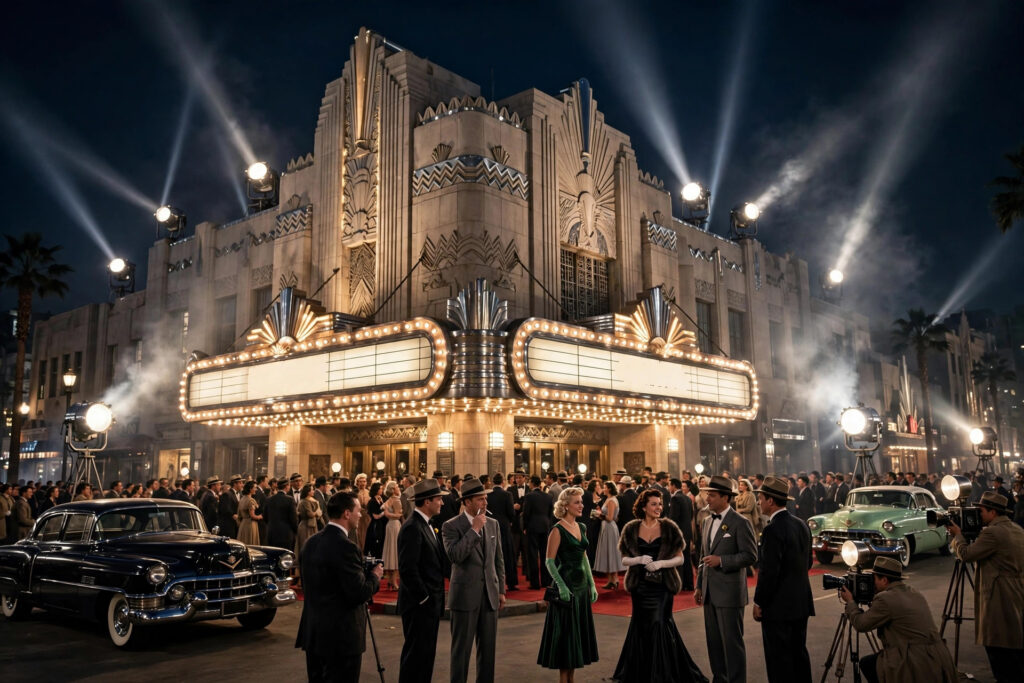
Classic Hollywood: Inside the Golden Age of Cinema
There was a time when the movies were the center of American life — when a handful of studios in a Los Angeles suburb manufactured dreams on an assembly line, when movie stars were treated like royalty, and when a Saturday night at the picture palace was the highlight of the week. This was Hollywood’s golden age, roughly spanning the 1930s through the 1950s, and its influence still shapes every film you watch today. Step back in time with us into the era of glamour, grandeur, and the greatest star-making machine the world has ever seen.
The Studio System: Dreams on an Assembly Line
Classic Hollywood was built on the studio system — a vertically integrated business model in which a few major studios controlled everything: production, distribution, and exhibition. The big studios owned the soundstages where films were shot, the distribution networks that delivered them, and the grand movie theaters where audiences watched them.
Inside the studio gates, filmmaking ran like a factory. Each studio kept a permanent roster of directors, writers, cinematographers, costume designers, and composers — all on salary, all assigned to projects by the front office. Sets were built on backlots, costumes came from in-house wardrobes, and music was composed by staff orchestras. A studio could churn out dozens of films a year with remarkable efficiency, and audiences came to recognize each studio’s signature style: the glossy romances of one, the gritty gangster pictures of another, the lavish musicals of a third.
Stars Weren’t Born — They Were Made
Perhaps the most fascinating invention of the golden age was the star system itself. Studios didn’t just hire actors; they manufactured celebrities. A promising young performer would be signed to a long-term contract — often seven years — and the studio would take complete control: a new name, a new look, acting lessons, voice coaching, and a carefully crafted public persona.
Publicity departments planted stories in fan magazines, arranged “romances” between contract players, and guarded stars’ private lives fiercely. The result was a pantheon of icons whose images were polished to perfection: the effortless charm, the smoky glamour, the wholesome girl-next-door. Audiences didn’t just watch these stars — they worshipped them. Fan mail arrived by the truckload, and a star’s name above the title could guarantee a hit. Many of these performers remain cultural legends decades later, proof of just how powerful the machine was.
The Genres That Defined an Era
The golden age gave birth to — or perfected — nearly every major American film genre:
- The musical — the crown jewel of the era. Lavish productions with hundreds of dancers, soaring orchestras, and stars who could sing, dance, and act. These were pure joy captured on film, and they showcased the era’s technical wizardry at its best.
- Film noir — shadowy crime dramas full of cynical detectives, dangerous dames, and rain-slicked city streets. Born partly from wartime anxiety, noir gave Hollywood its darkest, most stylish edge.
- The western — sweeping tales of the frontier that mythologized American history. Shot against monumental landscapes, westerns offered adventure, moral clarity, and some of the most iconic imagery in all of cinema.
- Screwball comedy — fast-talking, madcap romances where battle-of-the-sexes banter flew at lightning speed. These films remain some of the funniest ever made, with dialogue that modern comedies still try to match.
- The epic — historical spectacles with casts of thousands, built to justify the biggest screens and the grandest theaters. When studios wanted to awe audiences, they went big — really big.
Technicolor and the Magic of Spectacle
It’s hard to overstate what color meant to audiences of the era. Most people lived in a world of black-and-white newspapers and photographs; then they walked into a theater and the screen exploded with the saturated reds, blues, and golds of Technicolor. Musicals, westerns, and adventure films used color as pure spectacle — every costume, every set, every sunset designed to dazzle.
But the magic went beyond color. This was the era of ingenious practical effects: painted backdrops so convincing audiences never questioned them, miniatures and matte paintings that created impossible worlds, and camera tricks accomplished entirely in-camera. Without a single computer, Hollywood’s craftspeople created illusions that still hold up — a testament to artistry over technology.
The Rules of the Game: Glamour With Guardrails
Golden-age Hollywood operated under a strict production code that governed what could appear on screen. Crime could never pay, married couples slept in twin beds, and even a kiss couldn’t linger too long. Filmmakers chafed against these restrictions — but the constraints also bred creativity. Directors learned to suggest rather than show, to smolder rather than state, and the resulting innuendo-laden dialogue and charged glances are often far more electric than anything explicit.
Behind the camera, the era was dominated by legendary filmmakers who thrived within the system: master storytellers who could deliver studio assignments on schedule while imprinting them with unmistakable personal style. The tension between art and commerce — between the director’s vision and the studio’s demands — produced some of the most enduring films ever made.
Going to the Movies: The Palace Era
The golden age wasn’t just about what was on the screen — it was about where you watched it. The great movie palaces of the era were architectural fantasies: marble lobbies, velvet curtains, gilded balconies, and ceilings painted like night skies with twinkling stars. Going to the movies was an event, an escape into luxury that cost only pocket change.
A typical night out was a full program, not just a single film. Audiences got a newsreel, a cartoon, a short subject, coming-attraction trailers, and then the main feature — often a double bill. Ushers in uniforms showed you to your seat with a flashlight. For a few hours, factory workers and bankers sat side by side in the dark, laughing and crying at the same stories. That shared, communal experience is something streaming — for all its convenience — has never quite replaced.
The Fall: Television and the End of an Era
No golden age lasts forever. In the late 1940s, a landmark antitrust ruling forced the studios to sell off their theater chains, breaking the vertical integration that had powered the system. Around the same time, a new rival appeared in American living rooms: television. Why go out to the movies when entertainment came to you for free?
Audiences shrank, the assembly line slowed, and the contract system crumbled as stars became free agents. By the early 1960s, the classic studio system was essentially gone. But Hollywood didn’t die — it reinvented itself, as it always does, giving rise to the director-driven cinema of the late 60s and the blockbuster era that followed.
The Legacy That Never Faded
Look closely at modern movies and you’ll see the golden age everywhere. The three-act structure, the grammar of editing, the language of genres — all were codified in this era. Every romantic comedy owes a debt to screwball; every superhero epic borrows from the spectacle playbook; every moody crime drama walks streets first paved by noir.
And the films themselves endure. Restored classics draw new audiences every year, film societies and streaming services keep them in circulation, and directors working today cite golden-age masters as their greatest influences. Even the way we talk about movies — “star power,” “the silver screen,” “a Hollywood ending” — comes from this era’s vocabulary. The stars may be gone, the studios transformed, but the magic remains intact — flickering on screens large and small, reminding us of a time when Hollywood didn’t just make movies. It made mythology.