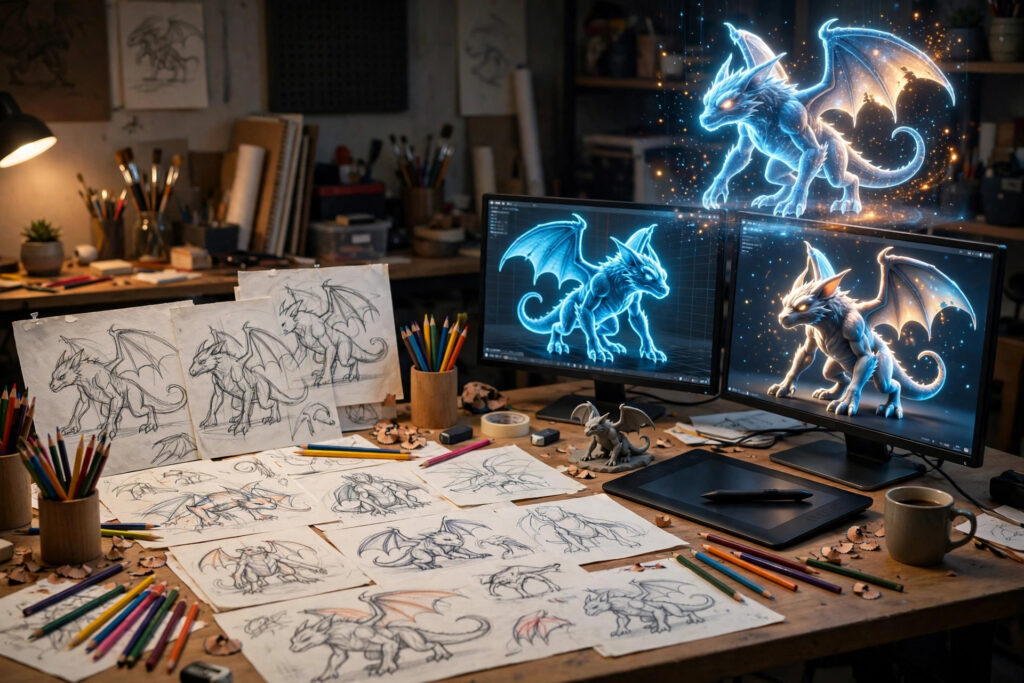
The Evolution of Animated Movies: From Hand-Drawn Classics to CGI
Before superheroes ruled the box office and streaming changed everything, animation was already cinema’s greatest magic trick. The idea that still drawings could come alive — that a character made of ink and paint could make an audience laugh, cry, and hold its breath — has fascinated people for over a century. Today, animated films are among the biggest blockbusters on the planet, powered by computers so advanced that every strand of fur and every ripple of water looks real. But this art form started with nothing more than paper, pencils, and extraordinary patience. This is the story of how animation grew from a hand-drawn novelty into one of the most powerful storytelling mediums in the world.
The Birth of Animation: Drawing Movies Into Existence
Animation is older than most people realize. In the early 1900s, inventors and artists were already experimenting with devices that made sequences of drawings appear to move — the flipbook being the simplest example. When cinema itself was still young, animators began photographing their drawings one frame at a time, creating short films that amazed audiences who had never seen anything like them.
These early cartoons were simple — black-and-white figures with rubbery limbs moving against plain backgrounds. But they introduced a revolutionary idea: in animation, anything was possible. A character could stretch, squash, fly, or transform in ways no live actor ever could. That freedom became animation’s defining trait, and it still is.
The real breakthrough came when animators synchronized their drawings with sound. Suddenly cartoons weren’t just moving pictures — they were performances. Characters could sing, speak, and tap-dance in perfect time with the music. The marriage of animation and sound changed the medium forever, and it wasn’t long before one cheerful mouse became the most recognizable character on earth.
The Golden Age of Hand-Drawn Animation
The decades that followed are often called animation’s golden age, and for good reason. Studios perfected the art of traditional hand-drawn animation — a labor-intensive process in which every second of screen time required 24 individual drawings. A single feature film could demand hundreds of thousands of drawings, each one done by hand by teams of artists who spent years on a single project.
This was animation as high craft. Animators studied real animals, visited forests for background reference, and developed principles — like squash and stretch and anticipation — that gave drawn characters weight and emotion. The results were films of breathtaking beauty, full of music, humor, and heart.
The golden age also established animation’s cultural role. Animated features became family traditions — the films children watched again and again, quoting every line and singing every song. They proved that cartoons weren’t just for kids; they were ambitious, emotional works of art that could stand alongside any live-action film.
But hand-drawn animation had limits. It was enormously expensive and slow. As audience tastes shifted and television rose in popularity, the grand theatrical cartoon began to lose its dominance. By the time the golden age faded, many assumed animation’s best days were behind it. They couldn’t have been more wrong.
Television Brings Cartoons Home
While theatrical animation declined, television gave cartoons a second life. Saturday morning cartoons became a beloved ritual for generations of kids, and animated series — from superhero adventures to slapstick comedies — filled living rooms every week.
TV animation worked under tighter budgets, so the style adapted: simpler designs, limited animation, and 22-minute episodes instead of two-hour epics. But what television lacked in polish, it made up for in variety. Entire generations grew up on cartoons made quickly and cheaply but loved fiercely.
Television also opened the door for animation aimed at adults. Prime-time animated sitcoms proved that cartoons could be sharp, satirical, and wildly popular with grown-up audiences. Late-night animation blocks pushed boundaries with surreal humor and experimental storytelling. Animation was no longer just a children’s medium — it was a versatile art form that could handle any genre or tone.
The Digital Revolution: The Rise of CGI
Everything changed again when computers entered the picture. Computer-generated imagery — CGI — allowed animators to build entire worlds in three dimensions instead of drawing them flat. Characters could be sculpted digitally, lit like real actors, and moved through space with cameras that flew anywhere the imagination could go.
The first fully computer-animated feature film was a revelation. Audiences had never seen anything like it — toys that felt genuinely alive, in a world rendered with depth, texture, and light. It proved that CGI wasn’t a gimmick but a whole new language for animation, and it launched a studio that would redefine the medium.
The digital era brought incredible technical advances. Fur, fabric, water, fire, and skin could all be simulated with growing realism. Animators learned to blend the emotional principles of traditional hand-drawn animation with the physical realism of computer graphics. The result was a string of beloved films that matched the emotional power of the hand-drawn classics while looking like nothing anyone had ever seen.
But CGI wasn’t just about realism. As the technology matured, filmmakers used it in stylized ways — worlds that looked like paintings, comic books, or living watercolors. The computer became a paintbrush, not just a camera, and animation entered one of its most creative periods.
The Disney Renaissance and the Pixar Era
Two names loom large over modern animation history, and they represent two different revolutions.
First came a renaissance at the studio that had invented the animated feature. After years of decline, a new generation of filmmakers returned to the grand musical tradition — sweeping songs, fairy-tale romance, and show-stopping villains. These films became massive cultural events, proving that audiences still hungered for beautifully crafted, emotionally rich animated stories. The renaissance restored animation’s prestige and inspired a generation of artists.
Then came the computer animation studio that changed everything. Its films combined cutting-edge technology with something rarer: storytelling of extraordinary emotional depth. These movies made audiences weep over toys, monsters, fish, and robots. They established a house style built on original concepts, meticulous craft, and the belief that animation could tackle any subject — grief, memory, growing up, letting go — with more honesty than live action ever could.
The interplay between these two traditions — the musical fairy tale and the emotional adventure — defined animation for decades. Other studios joined in with their own styles, and audiences got an explosion of animated storytelling unlike anything before.
Anime’s Global Influence
No history of animation is complete without anime. Japanese animation developed its own distinct traditions — dramatic storytelling, complex characters, cinematic framing, and a willingness to explore genres and themes that Western animation rarely touched. Anime spanned everything from epic fantasy to intimate romance to mind-bending science fiction, and it was aimed at audiences of all ages.
For decades, anime was a niche interest outside Japan. But the internet changed that. Streaming platforms made vast libraries of anime available worldwide, and a new generation discovered what Japanese fans had known for years: animation could be as ambitious, emotional, and artistically daring as any medium on earth.
Anime’s influence on global animation is now everywhere. Western filmmakers borrow its visual language, pacing, and emotional intensity. This cross-pollination has made the entire medium richer, more diverse, and more exciting.
The Modern Era: A Renaissance of Styles
Today, animation is in the middle of a creative renaissance. The dominance of one style — whether hand-drawn or photorealistic CGI — has given way to a glorious variety. Recent animated films have looked like living comic books, oil paintings, stop-motion dreams, and bold graphic experiments. Filmmakers are using every tool available, often mixing techniques within a single film.
This diversity reflects animation’s true strength: it’s not a genre, it’s a medium. Animation can tell any story in any style. It can be a fairy tale or a documentary, a comedy or a tragedy, aimed at toddlers or at adults. The modern era has finally embraced that versatility, and audiences have responded with enthusiasm.
Independent and international animation has flourished too. Films from smaller countries and indie creators have won major awards and found global audiences, proving great animation needs vision and craft more than a massive budget.
The Future of Animation
So what comes next? The technology keeps advancing — real-time rendering, virtual production, and artificial intelligence are all reshaping how animated films get made. Some of these tools will make animation faster and cheaper; others will open up entirely new creative possibilities.
But history teaches one consistent lesson: technology is never the point. Every revolution — from synchronized sound to CGI — mattered because artists used it to tell better stories. What makes animation endure is the same thing that made those first flickering drawings magical: human imagination, drawn to life one frame at a time.
The evolution of animated movies is really the evolution of storytelling itself. From hand-drawn classics to CGI blockbusters to whatever comes next, animation has always been about one simple, miraculous idea — that drawings can dream. And as long as artists keep dreaming, animation will keep evolving.